The steps in the production process for flexible packaging
Producing flexible packaging is a technical process where material selection, precision and process control come together. Each step influences the quality, functionality and reliability of the final pack. Insight into the production process is essential, for both standard solutions and custom work, to develop packaging that performs without issues.
At DaklaPack, the entire packaging production process is set up for repeatability and scalability. Below, we explain step by step how our high-quality flexible packaging is produced, from raw material to a shipping-ready product.

Step 1: Selecting the raw materials
The right raw material is the foundation of every flexible packaging. In this step, we determine which type of plastic best suits the product, the application and the intended use. We look not only at shape and appearance, but above all at protection, safety and performance across the entire supply chain. Sustainability also plays a direct role here.
Liquid products require different films from powders and solid products. Depending on the product, we select mono-material structures or multi-layer films. The composition and thickness determine barrier properties against air, moisture and light. Sometimes a robust, well-sealing pack is sufficient, while other products need extra protection to safeguard quality, shelf life or safety. For aggressive or chemical products, material selection is crucial to prevent substances from migrating out of the packaging.
High-quality flexible packaging
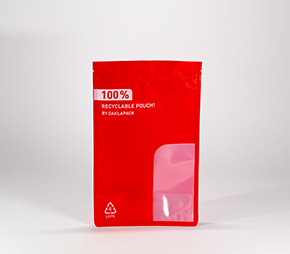
From film to functional packaging
- Step 2: Film extrusion
- Step 3: Printing the film
- Step 4: Laminating the film
- Step 5: Cutting and slitting
- Stap 6: Bagmaking
After selecting the raw materials, extrusion follows. In this step, plastic granules and additives are heated and formed into a flat or blown film that is wound onto rolls. The quality of this film is decisive for strength, flexibility and processability in the next steps. Properties such as thickness, uniformity and mechanical strength are strictly controlled.
If the film will later be printed or laminated, a pre-treatment is carried out at this stage. This ensures ink adheres optimally to the material and the print remains stable, without rubbing off or fading. For laminated packaging, the film is treated so adhesive layers bond properly. This contributes to strength, safety and consistent packaging quality.

In this step, the design is applied to the film. Colours, text and images are printed with high precision, so every pack looks consistent and recognisable. This is done using advanced printing presses that can print up to ten colours. The appearance stays the same, regardless of run size or repeat orders, and the end result meets the visual requirements of brand and market.
The choice of print technique depends on the material, the design and the desired look. For smaller runs or quick turnarounds, flexographic printing is often used, while gravure is suitable for high volumes and highly detailed designs. Special finishes such as hot foil can be used for premium accents. After printing, the ink is cured so it does not rub off and leaves no odour. This is essential for both product safety and quality.
After printing, the film is laminated. Multiple film layers are bonded together into a strong, functional structure. Each layer has its own role, such as protection against air, moisture or light, or providing extra strength. By combining different materials and layer thicknesses, we create a film that is optimally matched to the product being packed.
At DaklaPack, the lamination process is carefully aligned with the required packaging properties, such as seal strength, stiffness and robustness during transport and use. After bonding, the film is given time to condition so the adhesive layers can fully cure. This ensures the layers remain firmly bonded and do not delaminate. The film is then ready for further processing.
After lamination, the film is converted to the required dimensions. Large film rolls are cut and slit into rolls with the correct width and length for the chosen packaging format. This creates precisely matched webs for components such as the front and back panels and any bottom gussets, for example for stand-up pouches. This ensures all parts align seamlessly in the next phase.
During cutting and slitting, functional details can be added, such as a tear line for controlled opening. Using laser perforation, a tear strip can be applied across the full width. This makes opening the packaging easy and predictable, while airtightness remains intact. These operations keep the film consistent and reliable, ready for the next production step.
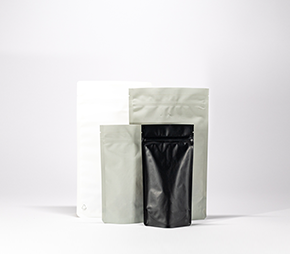
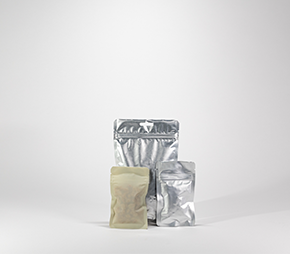
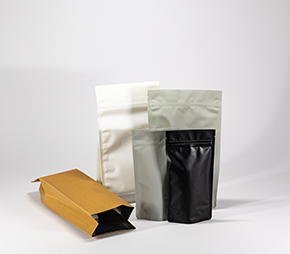
In this step, the film is turned into the actual flexible packaging. The film is folded, sealed and cut into bags or pouches in the required shape and size. Depending on the application, different types of flexible packaging are created, such as flat bags, stand-up pouches, side gusset bags, box pouches or other solutions.
The bagmaking process is carried out with precision, so every packaging is consistent in shape, dimensions and sealing. Interim checks take place during production to ensure quality and reliability. This applies to both small series and large-scale production. The result is packaging that is technically correct and ready for functional add-ons or filling.
Step 7: Functional add-ons
In this phase, we add functional elements that make packaging user-friendly and practical. Think resealable grip seals, tear notches, euro holes for hanging, or vent holes for applications such as e-commerce clothing packaging. Packaging can also be fitted with adhesive strips, tape or security closures, as used for envelopes and safety bags. These additions ensure the packaging fits the moment of use and the logistical application.
Depending on the packaging type, requirements and order volume, functional add-ons are integrated into the bagmaking process or applied by DaklaPack as a separate finishing step. Packaging can also be labelled or fitted with unique barcodes that are linked and registered. Where required, this is done under controlled conditions in our own cleanroom. This ensures quality and reliability, regardless of packaging complexity.
Spout inserting and dispensing solutions
For liquid products, flexible packaging can be fitted with a convenient spout, a rigid, closable pouring or dispensing opening. Each spout is firmly sealed into the packaging and can be finished with a resealable cap. DaklaPack offers various colours, sizes and designs, for example for soap, oil or other liquids.
Spouts can be placed centrally or in a corner using specific sealing techniques. Several closure types are available, including standard caps, child-resistant caps and solutions for retail refill concepts. In this way, spout inserting improves ease of use, packaging safety and more sustainable applications.

Step 8: Quality control
Quality control is an integral part of DaklaPack’s entire production process. During and after each step, checks are carried out, from film and printing to lamination and bagmaking. Packaging is checked for dimensions, seal strength, colour consistency, and overall strength and load resistance. This ensures every flexible pack performs as intended, regardless of run size or application.
In addition, packaging is tested for leakage and closure integrity, including water and pressure tests. This is essential to provide assurance during transport, storage and use, especially for liquid or chemical products. The packaging we produce is not only technically correct, but also demonstrably compliant with relevant laws and regulations. On request, quality samples can be retained for up to a year as reference.

Step 9: Packing and dispatch
Once the final quality checks are complete, the packaging is carefully packed and prepared for dispatch. We supply packaging on rolls or as individual bags, aligned with your filling process and logistical set-up. Products are packed securely and delivered on time, ready for immediate use or further processing such as filling.
If required, DaklaPack can also fill the packaging as an additional service. In our cleanroom, packaging can be labelled, spouts can be sealed in, and products can be further prepared for dispatch. This ensures packaging is not only produced correctly, but delivered to you fully ready to use.
Frequently Asked Questions

Choose certainty in your packaging production
At DaklaPack, you can rely on the complete production of flexible packaging. From raw material selection and film production to an end product that is ready to use. As a manufacturer and experienced production partner, we supply both standard packaging and more complex custom solutions. We offer repeatability and scalability within one smooth, end-to-end process.
Contact our team on (201) 630-6480, e-mail info@daklapack.us or use the form on this page. Our specialists are ready to help you find the right packaging solution.